Category

AI & Digital Marketing

Category

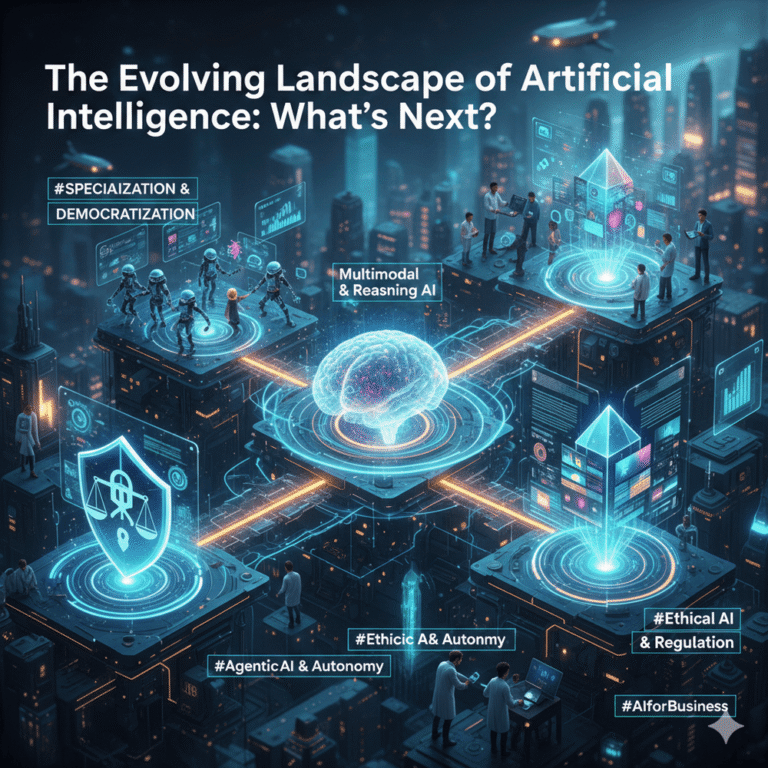
Only a few years ago, we talked about AI as a fancy search engine or a clever autocomplete. But as we close out 2025, the conversation has fundamentally shifted. We are no longer just “using” AI; we are managing it. This is the year of Agentic AI—autonomous systems that don’t just answer questions, but execute complex workflows.

1. The Rise of the “Super Agent”

In early 2024, AI could write an email. By late 2025, “Super Agents” are now capable of orchestrating entire projects. Imagine an AI that doesn’t just suggest a travel itinerary, but checks your flight status, rebooks a missed connection based on your frequent flyer preferences, and notifies your hotel—all without you lifting a finger.

This shift from generative (creating content) to agentic (taking action) is redefining productivity. Small business owners are now leveraging “AIsquads“—multimodal systems that handle everything from real-time customer support in 40+ languages to predictive inventory management.

2. The Great Efficiency Re-Evaluation

Despite the hype, 2025 has brought a “sobering up” for many enterprises. A recent study by MIT found that while the potential is massive, many organizations are still struggling to find a clear Return on Investment (ROI).

The successful companies aren’t the ones trying to replace humans; they are the ones using AI to solve “boring” problems:

  • Healthcare: AI is now a standard second set of eyes for radiologists, reducing diagnostic errors in X-rays and MRIs.

  • Sustainability: Smart grids powered by Edge AI are helping cities reduce energy waste by processing data locally rather than in distant, power-hungry data centers.

  • Cybersecurity: It’s an arms race. While criminals use AI to craft “deepfake” phishing attempts, defenders use AI-driven biometric authentication to stop them in real-time.

3. The Ethics of “Black Box” Decisions

As AI takes more actions on our behalf, the question of Explainable AI (XAI) has become a top priority. If an AI agent denies a loan or filters a job application, we need to know why.

The EU AI Act has set the global benchmark this year, pushing for:

  • Transparency: Clearly labeling AI-generated content.

  • Accountability: Ensuring humans remain “in the loop” for high-stakes decisions.

  • Bias Mitigation: Actively auditing datasets to ensure AI doesn’t inherit historical human prejudices.

The Bottom Line: Human-Centric Innovation

The most important trend of 2025 isn’t a new algorithm—it’s the realization that AI is a mirror. It reflects our data, our goals, and our values. As we move into 2026, the goal isn’t just to make AI smarter; it’s to make it more responsible, sustainable, and human-aligned.


Tips for Writing Your Own Plagiarism-Free AI Blog:

  1. Use Personal Anecdotes: AI can’t replicate your unique experiences. Mention how a specific tool helped (or failed) you.

  2. Synthesis over Summary: Don’t just list features. Explain how these features change the way a specific industry (like teaching or law) operates.

  3. Check Your Sources: If you use a specific statistic (like the $15.7 trillion global economy projection), always attribute it to the original study (e.g., PwC).

  4. Add a “Human Layer”: Use AI to generate an outline or research points, but write the final prose yourself to ensure a consistent, authentic voice.

ArtificialIntelligence (AI) is no longer a concept confined to science fiction or research laboratories. It has quietly woven itself into everyday life, influencing how we work, learn, communicate, and make decisions. From recommending the next song you might like to helping doctors detect diseases earlier, AI is reshaping the world in ways both subtle and profound.

What Is Artificial Intelligence?

At its core, Artificial Intelligence refers to computer systems designed to perform tasks that typically require human intelligence. These tasks include learning from experience, recognizing patterns, understanding language, solving problems, and even making predictions. Unlike traditional software that follows fixed rules, AI systems can adapt and improve as they process more data.

How AI Is Used Today

AI has found applications across nearly every industry:

  • Healthcare: AI tools assist in medical imaging, drug discovery, and patient monitoring, enabling faster and more accurate diagnoses.

  • Education: Personalized learning platforms use AI to adapt lessons to individual students’ strengths and weaknesses.

  • Business: Companies rely on AI for customer support chatbots, demand forecasting, fraud detection, and data analysis.

  • Daily Life: Virtual assistants, navigation apps, smart home devices, and recommendation systems are all powered by AI.

These applications demonstrate how AI enhances efficiency and helps humans focus on more creative and strategic tasks.

Benefits of Artificial Intelligence

One of AI’s greatest strengths is its ability to process vast amounts of information quickly and accurately. This leads to better decision-making, reduced human error, and increased productivity. AI can also perform repetitive or dangerous tasks, improving workplace safety and freeing people from monotonous work.

Additionally, AI opens new opportunities for innovation. Startups and researchers use AI to solve complex problems, from climate modeling to improving accessibility for people with disabilities.

Challenges and Ethical Concerns

Despite its advantages, AI also raises important concerns. Issues such as data privacy, algorithmic bias, and job displacement must be carefully addressed. When AI systems are trained on biased or incomplete data, they can produce unfair or inaccurate results. There is also a growing need for transparency so people understand how AI systems make decisions that affect their lives.

Responsible development and clear ethical guidelines are essential to ensure AIbenefits society as a whole.

The Future of AI

Looking ahead, AI is expected to become even more integrated into our lives. Advances in machine learning and natural language processing will make AIsystems more intuitive and collaborative. Rather than replacing humans, the future of AI lies in partnership—augmenting human abilities and supporting smarter, more informed choices.

Conclusion

Artificial Intelligence is a powerful tool that is transforming the modern world. When developed and used responsibly, it has the potential to improve lives, drive innovation, and solve some of humanity’s most pressing challenges. As AI continues to evolve, understanding its capabilities and limitations will be key to shaping a future where technology truly serves people.

ArtificialIntelligence has moved from science-fiction dream to everyday reality at astonishing speed. Once limited to research labs and niche applications, AI is now woven into nearly every part of modern life—from predicting what we want to watch to detecting diseases earlier than ever before. As the technology continues to evolve, it raises new possibilities, new challenges, and new responsibilities for individuals and organizations.

AI as a Partner, Not a Replacement

One of the biggest misconceptions about AI is that it will replace humans entirely. In truth, the most powerful applications of AI emerge when humans and machines collaborate. AI excels at processing massive amounts of data, spotting patterns, and automating repetitive tasks. Humans bring context, creativity, empathy, and ethical reasoning—qualities machines can’t replicate.

The future belongs to hybrid intelligence: teams where humans handle the “why” and machines handle the “how.”

Everyday AI Is Becoming Invisible

AI used to feel like a futuristic add-on; now it’s quietly running behind the scenes. When your phone suggests the quickest route home, or when your email filters out spam, AI is working invisibly. This shift means that AI is no longer a technology we consciously use; it’s a layer that enhances how we interact with the world, often without us noticing.

As AI gets better at understanding language, images, and behavior, it will continue to dissolve into the background—quietly improving our experiences in subtle but powerful ways.

The Rise of Ethical and Responsible AI

With great capability comes great responsibility. As AI becomes more powerful, conversations about ethics have become more urgent. How do we prevent harmful biases in AI systems? Who is responsible when an algorithm makes a wrong decision? How can we ensure AI benefits everyone, not just a select few?

Responsible AI means transparency, fairness, accountability, and safety. Companies and governments are now developing frameworks to ensure that AI systems are trustworthy from the outset rather than being fixed after problems arise.

AI in Creativity and Innovation

AI is no longer limited to technicalfields. It’s collaborating with artists, writers, musicians, and designers to produce entirely new forms of creativity. Instead of replacing creators, AI is opening new doors—helping generate ideas, explore variations, and push creative boundaries.

We’re entering an era where creativity is amplified, not automated.

What the Future Holds

Looking ahead, AI will likely transform areas such as:

  • Healthcare: more accurate diagnostics and personalized treatments

  • Education: adaptivelearning experiences tailored to each student

  • Work: automation of routine tasks and the rise of new job roles

  • Climate science: faster modeling and better predictions

  • Accessibility: tools that break down communication and mobility barriers

AI’s potential is vast, but its impact depends on how we choose to shape it. If guided thoughtfully, AI can be one of the most empowering tools humanity has ever created.

#FutureofAI#GenerativeAI#AIinHealthcare#EthicalAI#AIEvolution#AgenticAI#VibesChanger#BuzzCreatorsDigitalMedia

ArtificialIntelligence (AI) has moved from the pages of science fiction to the center of modern innovation. What once seemed like futuristic speculation is now embedded in our daily lives—from the way we shop to how we communicate and even how we make decisions. As AI continues to advance, it’s reshaping industries, expanding human capabilities, and raising important questions about our future.

AI in Everyday Life

Most people interact with AI without even realizing it. Voice assistants help set reminders, search engines refine results based on behavior, and streaming platforms recommend shows using complex algorithms. These small interactions reflect a broader trend: AI is becoming a quiet partner in countless daily tasks, making experiences smoother and more personalized.

Reinventing Industries

Businesses across the globe are embracing AI to enhance efficiency and gain new insights.

  • Healthcare sees AI-powered tools detecting diseases earlier than traditional methods.

  • Finance uses machine learning to detect fraud and forecast market trends.

  • Manufacturing benefits from automation and predictive maintenance that keep production lines running smoothly.

As AI continues to mature, it’s helping organizations work smarter rather than harder.

Creativity Powered by Machines

AI is no longer limited to processing data—it’s creating. Tools that generate art, music, and writing are becoming more common, opening the door to new forms of creativity. Rather than replacing human imagination, these systems often act as collaborators, offering fresh ideas or refining rough concepts.

Ethics and Responsibility

With such transformative power comes significant responsibility. Discussions around ethics—privacy, transparency, bias, and job displacement—are now central to AIdevelopment. Ensuring that AI systems are fair, trustworthy, and beneficial to all is one of the biggest challenges of the coming decade.

A Future Shaped Together

AI isn’t just a technological trend; it’s a shift in how we solve problems and understand the world. As humans continue to guide and shape its development, we have the opportunity to ensure that AI serves as a force for good. The future of AI is not predetermined—it’s something we build together.

#ArtificialIntelligence

#AI

#MachineLearning

#DeepLearning

#Technology

#VibesChanger

#BuzzCreatorsDigitalMedia

Artificial intelligence is no longer a concept confined to science fiction; it’s the invisible engine shaping our daily lives, from recommending our next watch on a streaming service to powering complex medical diagnostics. The recent leap in generative AI has captivated the world, but as the technology accelerates, our focus must shift from simply what AI can do to how we ensure it does good. The true revolution won’t be in the code, but in the ethical frameworks we build around it.


The Double-Edged Sword of Automation

AI promises a future of unprecedented efficiency. We see estimates of its potential to add trillions to the global economy and automate hundreds of millions of repetitive tasks. This isn’t just about cost savings; it’s about freeing human creativity and effort for more complex, empathetic, and innovative work.

  • The Upside: Enhanced productivity, breakthroughs in medicine (personalized treatment plans), and solving complex global problems like climate modeling.

  • The Shadow: Significant job disruption is inevitable, particularly in roles involving routine data processing and customer service. Beyond this, a deeper threat lies in the subtle embedding of human imperfections into machine logic.


 The Critical Importance of Ethical AI

The core challenge in AI development is that these systems learn from the data we feed them—and our historical data is often rife with bias, inequality, and outdated assumptions. When an AI model is trained on skewed data, it doesn’t just replicate those biases; it amplifies them, creating a feedback loop that can lead to discriminatory outcomes in sensitive areas like hiring, loan applications, and criminal justice.

This is where ethical design becomes paramount. It’s about recognizing the power we are handing over to algorithms and establishing clear boundaries.


Key Ethical Pillars We Must Uphold:

  1. Fairness and Non-Discrimination: Developers must actively audit training data and algorithms to proactively remove biases, ensuring AI systems treat all demographic groups equitably.

  2. Transparency and Explainability (XAI): We need to move away from “black box” models. Users and regulators must be able to understand how an AI reached a decision, especially in high-stakes fields like healthcare or law.

  3. Privacy and Data Protection: Given AI’s insatiable hunger for data, strict rules must govern the collection, storage, and use of personal information, prioritizing user consent and confidentiality.

  4. Human Oversight and Accountability: AI should serve as an augmenting tool, not a replacement for human judgment. Clear lines of responsibility must be drawn so that when an AIsystem causes harm, we know who is accountable.


 Charting the Future: A Human-Centric Approach

The road ahead requires a shift in perspective. We shouldn’t develop AI for the sake of technology; we must develop it for the sake of humanity. This means integrating ethical training into engineering programs, encouraging multi-stakeholder dialogue between tech leaders, policymakers, and civil society, and adopting a human-centric design model.

The most successful AI innovations of the next decade won’t just be the fastest or the most powerful—they will be the ones that are trusted. They will be the systems that augment our unique human capabilities like creativity, critical thinking, and empathy, rather than attempting to supplant them entirely.

The AI revolution is here, but its final chapter is still being written. It’s up to us to ensure that the intelligence we create reflects our highest moral values, building a future where technology uplifts everyone.

#AI

#ArtificialIntelligence

#FutureOfTech

#TechForGood

#Innovation

#VibesChanger

#BuzzCreatorsDigitalMedia

ArtificialIntelligence (AI) isn’t just a futuristic concept confined to sci-fi films; it’s the engine room of the 21st century, subtly reshaping our world one algorithm at a time. Far from simply being autonomous robots, AI is the science of teaching machines to simulate human intelligence—to learn, reason, perceive, and make decisions. Understanding this revolution is essential, not just for technologists, but for everyone navigating the modern landscape.


What is AI, Really?

At its core, AI is a field of computer science dedicated to creating systems that can perform tasks traditionally requiring human intelligence. This ranges from the simple (like finding the optimal route on a GPS) to the complex (like a medical diagnosis).

The AI we primarily see today is often referred to as Narrow AI (or Weak AI). This technology is highly proficient at a specific task—think virtual assistants like Siri and Alexa, advanced web search engines, or the recommendation systems on Netflix. These systems are powered by sophisticated subfields like:

  • Machine Learning (ML): Teaching computers to learn from data without being explicitly programmed. This is where the machine improves its performance over time.

  • Natural Language Processing (NLP): Allowing machines to understand, interpret, and generate human language, making tools like this blog post possible.

  • Computer Vision: Enabling machines to “see” and interpret visual information, crucial for self-driving cars and facial recognition.


⚡ The Transformative Impact on Daily Life

AI’s influence is no longer theoretical; it’s a practical reality driving major shifts across industries:

  • Healthcare: AI is accelerating drug discovery, helping to analyze medical images (like X-rays and MRIs) with remarkable accuracy, and assisting doctors in creating personalized treatment plans.

  • Automation in Business: Repetitive and tedious tasks, from data entry to customer service triage via chatbots, are being automated. This frees human workers to focus on higher-value, more creative, and emotionally engaging work.

  • Personalization: From the articles you see in your news feed to the products you’re recommended online, AI models are continuously refining your digital experience to be more relevant and efficient.


⚖️ Navigating the Ethical Maze

As AIsystems become more powerful, new ethical questions arise that we must address proactively.

Bias and Fairness

AI models are trained on historical data, and if that data reflects existing societal biases (related to gender, race, or socioeconomic status), the AI will learn and potentially amplify those same unfair outcomes. The push for Explainable AI (XAI) is a vital effort to open the “black box” of algorithms, helping us understand how decisions are made and ensuring fairness.

Privacy and Ownership

The engine of modern AI is data. As more personal information is collected and used to train models, concerns about data privacy and surveillance escalate. Furthermore, when generative AI creates art, music, or text, the issue of intellectual property and who truly owns the output remains a complex, evolving challenge for legal frameworks.


🚀 The Road Ahead: The Future of AI

Looking forward, the ultimate, long-term goal for many researchers is ArtificialGeneralIntelligence (AGI)—a hypothetical machine with the ability to understand, learn, and apply its intelligence to solve any problem a human being can. While AGI remains a distant concept, the journey toward it promises continuous breakthroughs in specialized AI.

The future will likely see AI becoming an even more integrated co-pilot in our lives:

  • Augmented Creativity: AI won’t just replace jobs; it will augment them, turning people into super-performers in their fields.

  • Hyper-Personalized Education: AI tutors will adapt lessons to individual student paces and learning styles.

  • Smarter Infrastructure: Cities will use AI to manage traffic, optimize energy consumption, and respond to emergencies in real-time.

The AI revolution is not about surrendering our intelligence to machines; it’s about building tools that allow us to focus on what makes us uniquely human: creativity, compassion, and critical thought. The journey is just beginning, and the responsibility to guide it ethically belongs to all of us.

#AI

#ArtificialIntelligence

#TechRevolution

#FutureofWork

#Innovation

#VibesChanger

#BuzzCreatorsDigitalMedia

ArtificialIntelligence (AI) is no longer a futuristic idea — it’s part of our daily lives. From voice assistants and chatbots to self-driving cars and advanced healthcare systems, AI is transforming how we live, work, and interact with technology.

What Is Artificial Intelligence?

At its core, Artificial Intelligence is the ability of machines to perform tasks that typically require humanintelligence. This includes learning from data, recognizing patterns, making decisions, and even understanding natural language. Simply put, AI enables computers to “think” and “learn” like humans — but much faster.

How AI Is Transforming Industries

AI is revolutionizing nearly every industry by improving efficiency and driving innovation:

  • Healthcare: AI helps doctors analyze medical images, predict diseases, and suggest treatment plans with remarkable accuracy.

  • Education: Personalized learning platforms use AI to adapt lessons to each student’s strengths and weaknesses.

  • Marketing: Businesses use AI to understand consumer behavior, automate campaigns, and improve customer engagement.

  • Finance: From fraud detection to smart investment advice, AI is reshaping financial decision-making.

  • Transportation: Autonomous vehicles and traffic management systems powered by AI are making travel safer and more efficient.

Benefits of AI

  1. Automation: AI reduces repetitive tasks, allowing people to focus on creative and strategic work.

  2. Accuracy: Machines can process massive amounts of data with precision.

  3. Speed: AI enables real-time decision-making that humans alone could not achieve.

  4. Cost Efficiency: By improving workflows, AI helps businesses save time and resources.

Challenges and Ethical Considerations

While AI brings many advantages, it also raises important questions. Issues like job displacement, data privacy, and algorithmic bias must be addressed carefully. Responsible AI development ensures that technology serves humanity — not replaces it.

The Future of AI

The future of AI looks promising. With continuous advancements in machine learning and neural networks, AI will continue to evolve, becoming even more integrated into our lives. The key is to balance innovation with ethics, ensuring that AI remains a tool for empowerment and positive change.


Conclusion

Artificial Intelligence is more than just a trend — it’s a driving force behind the digital transformation of the modern world. As AI continues to grow, those who understand and embrace it will lead the way in shaping a smarter, more connected future. 

#ArtificialIntelligence #AI #FutureOfTechnology #Innovation #MachineLearning #TechTrends #DigitalTransformation #SmartTechnology #Automation #AIRevolution #VibesChanger #BuzzCreatorsDigitalMedia

In today’s fast-evolving world, ArtificialIntelligence (AI) is no longer a futuristic idea — it’s a powerful force that’s redefining how we live, work, and connect. From voice assistants to predictive analytics, AI is transforming industries, empowering businesses, and reshaping everyday experiences.

What Is Artificial Intelligence?

At its core, AI refers to the ability of machines to perform tasks that typically require human intelligence — such as learning, reasoning, problem-solving, and decision-making. In simple terms, AI enables computers and systems to think, analyze, and adapt just like humans, but often faster and more efficiently.

How AI Is Changing the World

AI’s impact can be seen across nearly every sector:

  • Healthcare: AI helps doctors detect diseases earlier through predictive diagnostics, medical imaging, and personalized treatment recommendations.

  • Business & Marketing: Companies use AI to understand customer behavior, automate workflows, and deliver personalized experiences that drive growth.

  • Education: AI-powered platforms adapt to each student’s learning pace, offering customized lessons and real-time feedback.

  • Transportation: Self-driving vehicles and smart traffic systems are reducing accidents and improving mobility.

  • Finance: AI algorithms detect fraud, analyze market trends, and assist in smarter investment decisions.

The Benefits of Embracing AI

AI offers a range of benefits that can transform both business and personal life:

  1. Efficiency & Automation: AI handles repetitive tasks, freeing up time for strategic thinking and creativity.

  2. Data-Driven Decisions: With AIanalytics, organizations can make smarter, faster, and more informed decisions.

  3. Personalization: From product recommendations to curated content, AI ensures users get experiences tailored to their needs.

  4. Innovation: AI fuels new possibilities — from smart homes to advanced robotics and beyond.

Challenges and the Human Touch

While AI brings immense opportunities, it also raises important questions around data privacy, ethics, and job displacement. However, the solution isn’t to fear AI — it’s to use it responsibly. Humans and AI can work together, with technology handling complex data and humans leading with creativity, empathy, and moral judgment.

The Future with AI

The future of AI is bright, and we’re only scratching the surface. As AI continues to advance, it will unlock innovations we can hardly imagine today — from smarter healthcare solutions to intelligent environmental systems that help sustain the planet.

But the key will always be balance — using AI as a tool to enhance human potential, not replace it.


Final Thoughts

Artificial Intelligence is not just a technological trend — it’s a revolution that’s shaping a smarter, more connected world. Those who learn to adapt, innovate, and collaborate with AI will lead the way into the future.

#ArtificialIntelligence
#AIInnovation
#FutureOfAI
#AIEvolution
#TechnologyTrends
#DigitalTransformation

#VibesChanger

#BuzzCreatorsDigitalMedia

ArtificialIntelligence, or AI, is no longer a futuristic idea—it’s a core part of our daily lives. From the moment we unlock our phones with facial recognition to the recommendations we see on social media, AI quietly powers much of the technology we rely on. But what exactly is AI, and how is it changing the way we live and work?

What Is Artificial Intelligence?

At its core, AI refers to the ability of machines to perform tasks that usually require humanintelligence. This includes learning from experience, recognizing patterns, making decisions, and even understanding natural language. AI systems are powered by algorithms and large datasets, enabling them to “learn” and improve over time without direct human programming.

Types of AI

AI can be divided into two main categories:

  1. Narrow AI: This type of AI is designed to handle specific tasks. Examples include voice assistants like Siri and Alexa, recommendation systems on Netflix, or spam filters in email.

  2. General AI: Still theoretical, general AI would have the ability to understand, learn, and perform any intellectual task that a human can. Researchers are working toward this goal, but it remains a challenge for now.

Applications Across Industries

AI is making a major impact in nearly every field:

  • Healthcare: AI helps doctors analyze medical images, predict diseases, and personalize treatment plans.

  • Education: Intelligent tutoring systems can adapt to a student’s learning pace and provide instant feedback.

  • Business: Companies use AI for customer service chatbots, fraud detection, and data-driven decision-making.

  • Transportation: Self-driving cars and smart traffic systems are revolutionizing how we move.

  • Creative Arts: AI-generated music, art, and writing are opening up new forms of expression and collaboration.

Ethical Considerations

As AI becomes more powerful, questions about privacy, bias, and accountability are growing. Who is responsible if an AI system makes a mistake? How do we ensure algorithms are fair and transparent? Ethical AI development aims to balance innovation with responsibility, ensuring that technology benefits everyone.

The Future of AI

The future of AI holds immense promise. We can expect more natural interactions between humans and machines, smarter automation, and deeper insights from data. However, the key will be in using AI wisely—enhancing human potential rather than replacing it.


In conclusion, Artificial Intelligence is not just a technological trend; it’s a fundamental shift in how we approach problem-solving and creativity. As AI continues to evolve, it will shape the next chapter of human progress—if we guide it with care, curiosity, and ethical foresight.

#ArtificialIntelligence

#AI

#MachineLearning

#DeepLearning

#NeuralNetworks

#DataScience

#Automation

#TechInnovation

#VibesChanger

#BuzzCreatorsDigitalMedia

Artificial Intelligence (AI) has become one of the most powerful forces shaping our modern world. From virtualassistants that simplify daily tasks to complex algorithms driving self-driving cars, AI is revolutionizing the way we live, work, and connect. What was once a futuristic idea is now deeply woven into our everyday lives, driving innovation across almost every industry.

At its core, AI refers to the ability of machines to mimic human intelligence — learning from data, recognizing patterns, and making decisions. Machine learning and deep learning, two branches of AI, have enabled systems to continuously improve their performance without human intervention. Whether it’s healthcare, finance, education, or entertainment, AI is helping organizations become more efficient and customer-focused.

One of the most remarkable aspects of AI is its adaptability. In healthcare, AI assists doctors in diagnosing diseases with greater accuracy. In business, it helps companies predict consumer behavior and optimize marketing strategies. Even in creative fields like music and design, AI tools are helping artists push the boundaries of imagination.

However, the rapid growth of AI also brings challenges. Ethical concerns about data privacy, job displacement, and algorithmic bias remind us that technology must be developed responsibly. Striking a balance between innovation and accountability will be key to ensuring AI benefits everyone.

In the end, AI is not here to replace humans but to empower them. When guided by ethical principles and human creativity, Artificial Intelligence has the potential to unlock limitless opportunities — transforming the future in ways we are only beginning to imagine.

#ArtificialIntelligence

#AIRevolution

#FutureOfTechnology

#MachineLearning

#DeepLearning

#VibesChanger

#BuzzCreatorsDigitalMedia